
Why doing more doesn't mean winning
Straight A’s in school. Puts everyone else first. Doesn’t ask for help because you’re good at figuring things out yourself… and yeah, probably a total badass. 💜
Those same habits can quietly spill into how you handle your money. Because the way we do one thing often mirrors how we do everything.
It might show up as overachieving with your money... refreshing your portfolio three times before lunch 💻, subscribing to every finance newsletter, podcast, and YouTube channel “just to stay ahead,” or feeling like you need to know everything before you make a move.
If that sounds like you… this is for you.
I get it. I love investing. I love learning, exploring strategies, and watching my money grow. (Wooohooo for getting RICH!!! 🎉)
But as a fellow overachiever, I also know what it’s like to crave control and how easily that spills into your money life.
There’s a fine line between curiosity and mental clutter… and it’s so easy to cross.
Why We Think Being “Active” Means Winning 🔮
Researching, hunting for the next best investment, learning how to make heaps of money — it’s all so fucking awesome.
There’s an endless stream of strategies, voices, and success stories out there and if you didn’t grow up around these kinds of conversations (like so many of us didn’t), it can feel incredible. It’s the thrill of finally having access to the information that can change your life, your family’s future, maybe even generations to come.
But that same determination? It comes with a dark side.
The obsession with always having to be on.
That energy can go one of two ways:
It can paralyse you (hello, analysis paralysis)... or it can quietly turn your investing into another job.
And when you already have a life, a business to run, kids to raise, a kitchen to clean, friends to see, a gym to get to, and probably a course you’re halfway through — your money ends up feeling like one more thing on your to-do list.
Social media has turned investing into a sport. TikTok tips, viral newsletters, podcasts, finance influencers, they make being active feel exciting .Here’s the trap: being active feels like control. Control feels like better returns. But research shows active investors often underperform passive strategies (Morningstar, 2021; Dalbar, 2022).
How to Invest Without Turning It Into Your Second Job 💫
Your investment strategy doesn’t have to be complicated to be powerful. You don’t need to be glued to market news, constantly adjusting, or trying to outsmart everyone else.
You just need structure — a few simple rules that protect your time and your returns.
And that’s where the Core–Satellite Approach comes in.
Think of Your Portfolio Like Your Wardrobe 👗✨
Your portfolio should make sense, just like your closet does.
You’ve got your everyday pieces, the ones you can rely on and your fun pieces, — the ones that make things interesting.
The Core = Your Classics
These are your staples. The black blazer. The white shirt. The jeans that always fit.
They might not be exciting, but they work.
This is 70–80% of your portfolio , your boring, dependable investments that do the heavy lifting quietly in the background. Think low-cost index funds or diversified ETFs that grow over time without needing your constant attention.
You don’t have to check them. You don’t have to tweak them.
They’re the “set and forget” part of your strategy, the foundation that lets you breathe.
The Satellite = Your Statement Pieces
Then there’s the other 20–30% — your “fun” money.
This is where you can play, experiment, and learn. Maybe you invest in a company you love, a sector you’re curious about, or a theme that excites you.
It’s the bold handbag, the glittery shoes, the jacket that makes you feel something. It’s still part of your wardrobe but it’s not what you rely on every day.
The same goes for investing.
Your satellites keep things interesting without risking your core foundation.
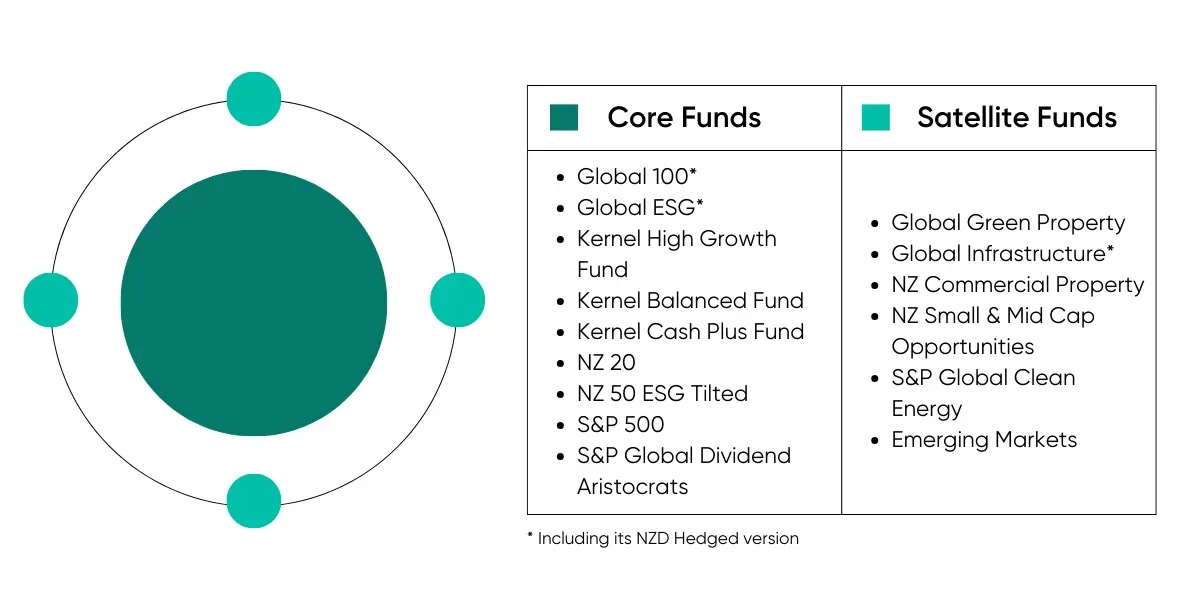
Image from Kernel Wealth, How Can Kernel Funds Fit Together? (2023)
Why This Works (And Why You’ll Actually Sleep Better)
💜 It balances safety and excitement
You get the best of both worlds, your stable core keeps your wealth growing steadily, while your satellite keeps investing fun and engaging.
💜 It stops the mental overload
You always know which part of your money is “hands-off” and which part is “hands-on.” You don’t have to question every decision or feel guilty for not checking your portfolio daily.
💜 It protects you emotionally
Even if your satellite investments dip (and they will sometimes), your core keeps you anchored. You’re still moving toward your long-term goals — without panic.
💜 It plays well with your brain
Fewer decisions = less stress. Research shows we make better financial choices when we reduce the number of decisions we have to make (Sweller, 1988). You’re not managing everything — just the small, fun slice.
Are You Overdoing It? 💜
Now that you’ve got a framework that actually works, it’s worth checking in with yourself. Because even with a solid system, it’s easy to slip back into “always-on” mode.
Ask yourself:
How much of your mental energy is tied up in researching, checking, or obsessing over investments — versus living your life?
Which sources genuinely teach or inspire you and which just make you feel behind?
How would it feel to trust your system, your rules, and your guardrails, instead of chasing perfection every day?
This isn’t about giving up curiosity. It’s about giving yourself space. Space to enjoy your life, your work, your relationships — while your money quietly grows in the background.
Investing doesn’t have to be complicated. It doesn’t have to feel like a second job.
With the right rules and a system that balances core stability with satellite exploration, you can stay engaged, stay curious, and even have fun — without burning out or overcomplicating things.
Simplicity isn’t boring. It’s confidence.
It’s freedom.
It’s your mental space back. 💫